Saturday, 24 November 2012

Creating Health (Revised Edition) – Deepak Chopra


Deepak Chopra focuses on the mind/body connection; the idea that the mind and body can work together to create optimum health or perilous disease and that by utilizing the forces of both, one can remain youthful, energetic and happy. Chopra declares that health is our natural state of being, but that many of us have lost sight of the importance of keeping ourselves well both physically, and spiritually.

Chopra initiates his work by focusing on the common ailments that he encounters daily. These include cancer, addictions, obesity, chronic fatigue, depression and sexual inadequacy. Though many of these ailments have probably existed since the dawn of time, Chopra explains that our modern day lifestyles, though advanced and evolved, have detached us from our animalistic, intuitive understanding of our well being. A world of immediate gratification and hedonism means that we can indulge ourselves in various bad habits, which in turn for many become addictions or ways of being, rather than pleasurable recreational escapes.

He then explores various case histories, which illustrates the mind/body connection in becoming well, including patients that have given up mentally (and so have their bodies) and others who have decided to fight and miraculously recovered.

Finally, he explains how all of us can create our own well of free-flowing health by incorporating certain strategies into our behaviour.

Many self-help/health books tend to focus on the same factors, but perhaps this is because, like clichéd lines, they are echoed because of the truth they contain. Their repetition is merely a matter of us allowing them to be engrained within our consciousness so that we may alter our own behaviours.

He stresses the importance of awareness of the self, focusing on the positives that we wish to bring into our life’s and not concentrating so much on the ‘tigers’ of depression or anxiety, which will consequently melt away like snow in the sun if we do not obsess about them. The common mantra is ‘what we resist persists’ perhaps until we learn the lesson it is willing to teach us. As such, we cannot resist the parts of us that we dislike. We can only accept them and work on our positives, so that our negatives do not hold so much sway over us.

He moves onto living in the present, without lamenting the past or ruminating over our futures, paying attention to how and where we seek to gratify our egos, gaining job satisfaction (perhaps harder to achieve in today’s economic climate), nourishing our bodies with healthy, delicious diets, paying attention to nature and the bodies conjoined rhythms, approaching life with an open mind, retaining a sense of wonder and belief, living with compassion and generating love.

It is clear that many people naturally operate from a place of openness and trust, particularly when they are raised with love and care. As we grow and endure disappointments, disillusionments, betrayals and hurts, we slowly clam up and close. We aren’t always so willing to give love, nor are we always willing to receive it. We perceive treachery and pain around us and question the intentions and motivations of others. We start to see kindness as weakness, generosity as submission, honesty as foolishness and so on, when really we know that the greatest sense of liberation and transcendence can only come from embracing these qualities and doing away with our sharp and pointy defences, that only seek to make enemies out of potential friends and con-men out of benefactors.

You may be familiar with the 'law/power of attraction', the idea that what we give out is what we get back. Chopra expands on this explaining that people that want love should give love first, people that want praise should praise others first, and this will naturally come back on us. The world is a place of abundance simply waiting for us to participate and claim what is rightfully ours. Everyone knows someone who is so positive, generous, compassionate, powerful or calm that others flock to their magnetic appeal, whilst others repel with their sense of entitlement, bitterness, fear, insecurity or anger. It is no coincidence that the healthy attract the healthy and the unhealthy attract the unhealthy, even if their problems are very different. A co-dependent woman may end up with a controlling partner. Both are sick, just in different ways. Their sickness is what draws them to one another. We can change what we attract by concentrating on what we consciously or unconsciously give out to others, and by how we respond.

It may not be easy to incorporate all of these teachings without feeling like you are lowering your defences somewhat, but a person can still operate with boundaries and walk away from any situation or individual that threatens to damage their physical/mental health in any way.

The lessons seem simple, but are much harder to actively do. Nonetheless, I couldn’t help but find Chopra’s thoughts very inspirational and I endeavour to develop these strategies myself.

Thursday, 15 November 2012

The beginnings of a bucket list...Part 1


I’ve recently decided that I am going to create a bucket list. I might keep it personal, or I might put it on my blog (it might be more exciting to make it interactive!). To motivate myself, I’ve decided to write a list of certain things that I can cross off the bucket list before officially ever starting it...because they’ve already happened. I don’t know what more incentive you can have to continue than to see where you’ve been. Some are small and some are more meaningful. It would be great to see what personal dreams, wishes or aspirations you have crossed off of your own bucket list :)

  • ·        Have a spontaneous kiss with a stranger

  • ·        Lie in a hammock and watch the stars with someone special

  • ·        Volunteer with elephants in Thailand

  • ·        Take a flight on my own

  • ·        Return to Thailand spontaneously

  • ·        Ride a banana boat

  • ·        Ride on the back of a motorbike

  • ·        Kiss a dolphin

  • ·        Swim with dolphins

  • ·        Swim with whale sharks

  • ·        Go camping

  • ·        Listen to people sing and play music around a campfire

  • ·        Sneak out

  • ·        Drive a speed boat

  • ·        Go paragliding

  • ·        Go jet skiing

  • ·        Swim in a lake with an elephant

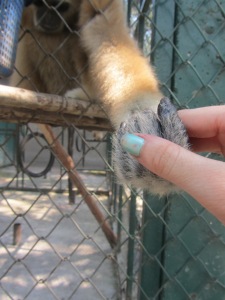
  • ·        Groom a gibbon

  • ·        Visit Chichen Itza

  • ·        Climb Koba

  • ·        Ride a camel on the beach

  • ·        Jump into a hot tub fully clothed

  • ·        Visit Venice

  • ·        Ride a gondola

  • ·        Find the beach from ‘Death in Venice’

  • ·        Visit Paris

  • ·        Watch the fireworks from the Eiffel tower

  • ·        Visit my relatives in France

  • ·        See a KPOP concert

  • ·        Get my bully button pierced

  • ·        Get three piercings in each ear

  • ·        Get a pinna ear piercing in each ear (okay....so one of them closed)

  • ·        Start photographing the moon

  • ·        Visit Disneyworld

  • ·        Visit Harry Potter World

  • ·        Visit the medina in Marrakech

  • ·        Swim in a cenote

  • ·        Be involved in a protest

  • ·        Start a blog

  • ·        Have a professional massage

  • ·        Take a massage class

  • ·        Buy a round the world ticket

  • ·        Submit poetry to an official competition

  • ·        Have my first bynote

  • ·        Start a novel

  • ·        Start meditating

  • ·        Study English Comparative Literature at University

  • ·        Fall in love

  • ·        Fall in love...again


I hope to be able to cross off a few more in the coming year! Feel free to share your own bucket list successes and future wishes! We often forget how many amazing things we have already seen, experienced and achieved, whilst we whittle away the time trying to cultivate more!

Sunday, 11 November 2012

Snow White and the Huntsman

Queen Ravenna: Men use women. They ruin us and when they are finished with us they toss us to the dogs like scraps.


Fairy tales are renowned for their ability to capture timeless truths for younger generations to enjoy. Snow White reveals the power of youth and purity and the envy it can evoke in others. Beauty and youth are blooms that reach their potent peak and then slowly begin to diminish, leaving the individual once in possession of their power, wearied and frustrated at nature’s fickle transience. This message seems even more meaningful today, in a world only growing increasingly enamoured with what it means to be young and beautiful and ever fatigued, even disgusted, with what it means to grow old.

The controversy surrounding Kristen Stewart’s affair with married director Rupert Sanders has eclipsed any attention the movie itself may be able to generate, as well as shattered the fantasies of Twilight fans everywhere but it’s still worth taking a look at Sanders retelling of a much loved story.


Kristen Stewart, fresh off the back of her fame as Bella Swan is endowed with an accessible girl-next-door type of pretty, and although she’s not ruby red lipped or raven haired, she does have the pale cream like complexion expected of Snow White. Charlize Theron abandons her leonine, gregarious nature to envelope herself in regal, detached, self-centred, icicle eyed beauty Queen Ravenna (like name, like nature – quite literally ravenous to consume the hearts of beauteous maidens to endow herself with their vitality). Chris Hemsworth (yes, I call him Thor too) is the solid, handsome, Neanderthal huntsman-cum-protector.

This film is visually striking, merging stark, bleak landscapes (like the woods) with fantastical, magical backdrops (like the fairies sanctuary). The language itself is poetic, simple but mesmerising, but unfortunately the film itself is forgettable. This is what I would refer to as ‘dark-lite’ storytelling; the film does centre on the darker nuances of the story, but this is ‘dark’ of the Twilight, teenage variety. Charlize is sumptuous as the beauty-mad Queen (although her accent can be a little slack at times) and the interpretation of her magic mirror is unique as is the all-female village where mothers have disfigured themselves to escape the wrath of the Queen, but the dwarves themselves (a hodgepodge of famous names including Bob Hoskins, Ray Winstone and Nick Frost) lack the all-consuming personality you might have expected.

All in all, this is an enjoyable movie and worth watching if you keep your expectations low and lose yourself in the visual imagery and the struggle for the only power many women recognise: the ability that their beauty and sexuality has to divide nations, drive men to war and cause many to lose their minds.

Sunday, 4 November 2012

Mise-en-scène: The Virgin Suicides

To revive my seldom used Media Studies skills I have decided to add a new section to my blog entitled: Mise-en-scene, to unravel what particular shots within various movies, in this case ‘The Virgin Suicides’ reveal about the characters, the tone of the film and its implications. Please do not read if you do not want the film spoilt for you!

Cecilia in the tree


Cecilia, the youngest of the Lisbon sisters, is depicted as a melancholy malcontent.  She is the first of the sisters to feel deeply discontent with life and ends up committing suicide. After her death, Cecilia haunts the sisters as well as the neighbourhood boys who revered them. The film juxtaposes the childlike fantasies of the girls with their deadening home life. The girls are constantly projecting themselves elsewhere; in dreams, costumes, photographs and in nature.

Here Cecilia is positioned on a tree. She is wearing white which represents purity and innocence but the adorning of her arm with a bracelet and her pose indicate that she is aware of her impending womanhood and all the implications this entails. She is looking upward, as if to suggest that even if this picturesque natural surrounding she is still restless. Her expression is wistful but also slightly bored, as if she is wishing to be somewhere else, but also understands that nowhere can fulfil her. The elm tree she rests on is dying which represents Cecilia’s own longing for, and eventual demise. Cecilia is part of the tree; part of its nature, its poison and its death. Cecilia almost looks like an angel, a bride for God, looking to heaven, bored and unsatisfied with life, and ready to depart. Cecilia is literally embracing her own death.

Cecilia's bracelets


The focus on the film is the death of childhood as we transition into adolescence. For the girls this death is also literal. Here Cecilia sits with her arms bandaged but she has also adorned her wrists with colourful bracelets. The juxtaposition with beauty and pain in the film is almost masochistic. The girls physically, visibly suffer behind the beauty of their belongings and paraphanaelia. Their suffering, which is represented physically by her self-harm, is literally hidden by the adorning of jewellery. She is bound and contained by her suffering. She is not able or free to express it openly. Notice the position of her hands, as if she were there to catch water, only her hands are closed. The colours are muted, soft and feminine – a stark contrast to red blood, further showing the subduing of Cecilia’s despair. Her suffering is literally contained, stifled, repressed and decorated, displayed to the world as a childish error rather than a cry for help.

Sisterhood


Here, Lux, Bonnie, Mary and Therese embrace and comfort one another. The girls are in transition between girlhood and womanhood, a time that is a blur for many culturally and socially. There is no clear definition of when a girl ceases to be a girl and is now a woman. The paraphernalia surrounding the girls echoes childhood: the pinks and the teddy bear on the floor. Lux and Bonnie specifically seek the comfort of their eldest sister Mary, like children, nestling into her. Mary has a knowing and maternal look on her face. Therese in particular is cast aside from the girls, draped suggestively in white like a sacrificial virgin, looking submissive and alert. She is ‘apart’ from the others; she is neither childlike nor maternal. The girls represent three particular states of women: the child, the mother and the whore. This represents the confusion the girls feel about their identities as women in terms of how they see themselves and how they are seen by others.

Lux, the car and the cigarette
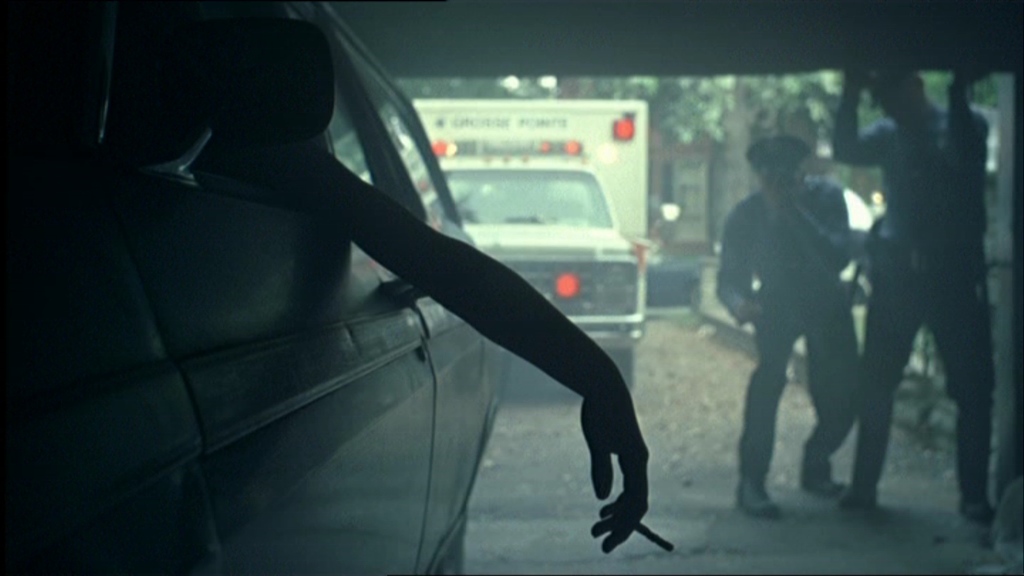


Lux is the last sister to kill herself. In this scene she is found by police whilst a police car and ambulance waits outside. Lux has made the transition from girl to woman. She is in the front seat of the car (possibly the driver’s seat) indicating that she is in charge and has made her own decision. She is clutching a cigarette in a limp hand which is indicative both of the poison in her own nature and the ‘maturity’ of her character. It is also an allude to her method of choice for suicide. Lux is happy to play at being a woman in terms of her promiscuity, but she doesn’t feel truly like a woman, as is evident in her boredom, her whimsy and escapism. The pose of the arm is almost suggestive and sexual, as if she is a grown woman soliciting attention.  Lux has been in the dark of the garage but the policeman (male figures) have opened the garage door and allowed light to enter. This might be indicative of Lux’s own awakening as a result of the loss of her virginity to trip, revealing to her another world which her parents refuse to let her into. She has been shut into her childhood, but eventually the light of adulthood will be let in.

Angels on the stairs
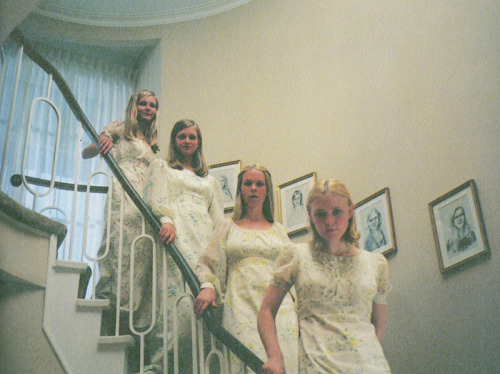


The Lisbon sisters are often depicted as unattainable, asexual and angelic. The boys revere and fantasize about them. They voyeuristically follow the girls, but they never know them. As such, the girls appear aloof, superficial and mysterious. This enables the boy’s fantasies of them to continue. To truly know them might dampen and damage their heightened perception of what the girls are. Here the girls are depicted before their prom standing on their stair way, like angels in heaven. This is exemplified by the sole use of the colour white. The dark rail alludes to the knowing nature that the girls cling to, the one link that binds them and also cements the idea that the girls have embraced death. The girls are not sexualised in this image. They are modestly dressed and appear virginal. Lux is placed at the highest point of the staircase as she is the girl most admired and adored by the neighbourhood boys. Interestingly, ‘Lux’ is Latin for ‘light’.

Cecilia in the bathtub


Cecilia appears dead, but she has slit her wrists and is lying in the bathtub. She looks tranquil, serene and accepting. The film often depicts life as misery and status and death as peace and freedom. Her gaze is fixed upwards as if she has found what she has been looking for. There is still a slight look of boredom on Cecilia’s face. This is typical of Cecilia, who is a fantasist but is essentially never pleased for very long. She looks like Ophelia, her hair splayed out around her. The blood in the bath is muted and almost pink and also signified the onset of Cecilia’s maturation. The light around her face is a blue white indicating purity but also coldness. The girls have always been seen as beautiful but unattainable. They are shiny veneers, but nobody has stopped to truly understand them.

Surrounding the tree


This picture is very telling. Again, the sisters look virginal, angelic and modest. They have shackled themselves to one of the local elm trees, which is due to be destroyed as it is contaminated. The girls feel a connection to the trees because they represent the girls own acceptance of and longing for death. The community wants to destroy the trees because they are sick and dying. They do not want the trees to contaminate the neighbourhood. What they do not understand is that the society inhabiting the neighbourhood is also sick. The girls realise this and are not afraid of death, unlike the neighbourhood, who would rather remove the trees than deal with the natural process of their demise.

Lux on the football field


Shortly after Lux loses her virginity to Trip after the prom, he abandons her on the football field. He later explains that he truly cared for Lux, but at that precise moment could not stand to be around her. He regrets that he was never able to tell her how he felt. The colours used are white, pink and blue. The colours are very muted as dawn emerges. Lux has woken up a new woman. She is literally no longer a child, in body or in mind. She has had her first experience of sex, disappointment and betrayal. This cements her own understanding life as a contaminated thing. She is lying on deadened grass on the football field (the traditional domain of men). She is still wearing her prom dress with the flower pinned to it. She is turning away from the camera, wistfully looking upward. The tone of the picture is melancholic. Lux looks vulnerable but also liberated. She has learnt that their love is crueller and colder than she expected. She now understands what her parents tried to shield her from, as much as she resents it. She is wizened by her first experience of love, betrayal and abandonment. Lux perhaps has a different incentive to the other sisters for suicide; she has learnt that she will be perceived as a fantasy object or as a sexual plaything; either the Madonna or the whore. As she does not see herself is either, she is forced instead to reject these inferences, removing herself altogether.

First love


Before Lux is betrayed by Trip, the two look like a fairytale couple. Lux is again looking upward, but this time not to the heavens, but into Trip’s eyes. Lux is dressed in white (again, virginal and innocent) and Trip in black symbolising experience but also corruption (his own corruption and his ‘corruption of Lux’). Again Lux means light, and Trip is the dark force that impedes her childlike existence and shows her the world she and her sisters are being protected from. We can visibly see Lux, after all, we are always voyeurs to the sister’s story, but Trip is hidden from us; unknown, deceptive and shady. The background is muted white and blue, looking like a starry night, but also warning us of the unhappy ending to the couple’s puppy love.

Surprise!
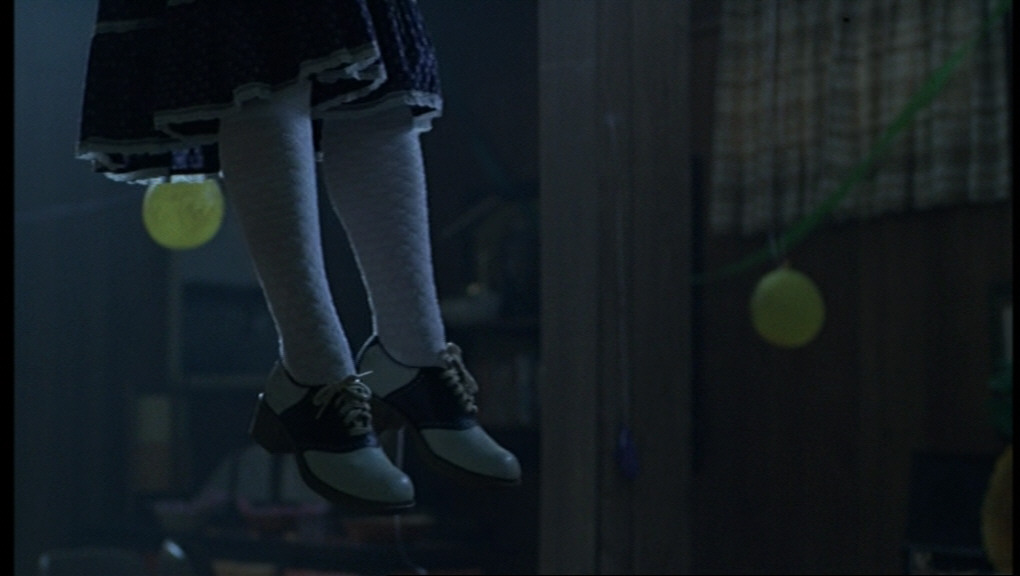


Death in this film is always shown as an escape or as something to be celebrated. Here Bonnie hangs herself, but she is dressed for the occasion and the room is strewn with party items, indicating that her death is more of a party than a tragedy. Of course, the imagery clashes horrifically with the family’s loss of their five beautiful daughters, but for the girls themselves, this was a premeditated plan with the intention to be liberated from the shackles of their family, religion and the expectations they have been entrenched in since birth.

Dreaming of Lux


Here, Lux is remembered by the neighbourhood boys. She and her sisters are immortalised by them. Lux is still depicted as an angelic thing, breaking through the summer sky amidst the puffy white clouds. She winks at the boys suggestively and teasingly. It is this contrast of innocence with maturity that the girls come to represent as if they know secrets that no-one else does. The faded essence of Lux implies that she is a memory, a fantasy – not a flesh and blood thing, and that the whole thing has always been a game.

Lux and the unicorn


The boys remember the girls through a filter. They envision them as fairytale things, similar to unicorns, the girls that the boys want can never really exist. Here Lux is faded again (she is still a dream/fantasy) and she is suggestively dressed. She represents joy, freedom and virility. This is the Lux that Lux wants to be (free) but also the Lux that the boys want (an intriguing mixture of innocent and sexual). She is mythologized beside the unicorn indicating the impossibility and naivety of their desire for her to be what they want. Lux can never be their fantasy thing. In death, she has become cemented as an idealised creation always available to them in their dreams. The sisters are as much an escape for the boys, as death is for the girls.

Girlhood items


Tellingly the girl’s belongings represent a clash of religious imagery and beauty products. The crucifix is pronounced and hangs over a perfume bottle like a noose representing the girl’s suffocation and guilt at being women. The items are chaotic and cluttered. Most of the items are coloured white and blue for purity, but the red nail varnish and amber bottles indicate a more sexual and attention seeking element. The products represent awareness of femininity, beauty and sexual appeal (highlighted further by the freedom represented by the birds) stifled or repressed by the religious icons, which evoke a sense of confusion and sin.

Cecilia's diary


The boys know the girls through Cecilia’s diary entries. They imagine her writing in a cornfield. Cecilia embodies escape and a desire for freedom. She is not enamoured with the physical world. Cecilia is often perceived in nature where she can be a natural thing, and not a construct. The golden colour highlights the sense of fantasy and nostalgia surrounding her.

Sickness, anyone?
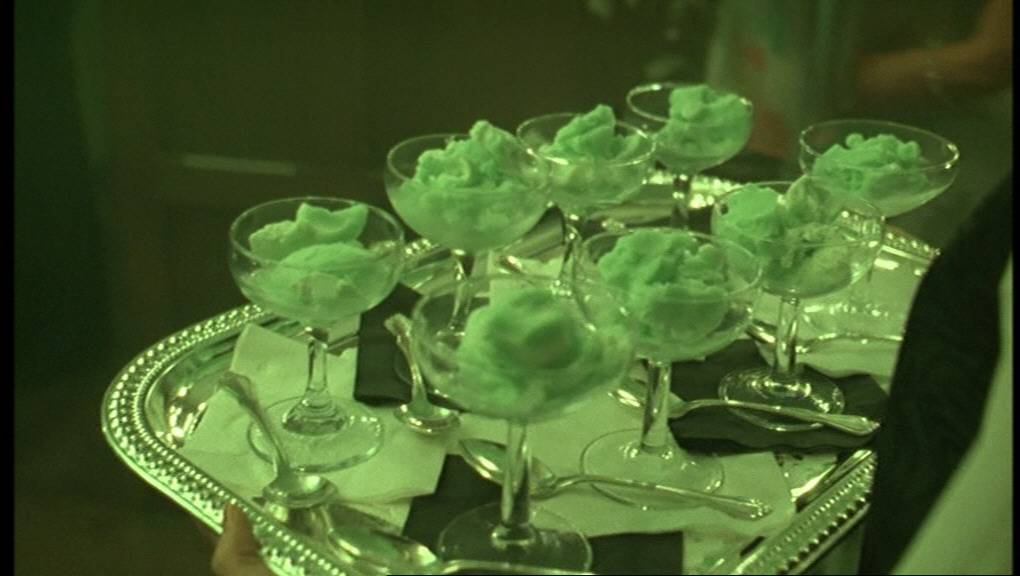


Green desserts and a green camera hue represent society’s sickness. The film focuses on the obsession with happiness at all costs and the inability to understand misery and mental illness. The green colour is a stark contrast to the earlier peaceful hues used, indicating that the neighbourhood is growing sicker, the contamination is here to stay and society is gorging itself on sickness.

Finger in the water


One of the girls has thrust her finger into a small tank of water, possibly housing sea monkeys. The hand itself is adorned with a ring, almost as if the child is a bride. The book below the tank reads ‘Sacred will of sacrifice’. The girl’s death is a preservation of themselves; their innocence, beauty and youth. Water is often associated with the unconscious and with femininity. The link between the girl and the world beneath the water suggests an understanding of her own subconscious mind (at the very bottom the need for sacrifice) and an acceptance of this, on her own terms. It also represents the effect of a penetrating outside force shifting the dynamic of a self-contained world. The girls own external experiences cause them to feel desperately unhappy in the stifling stasis of their childhood home.

Tuesday, 30 October 2012

Rose Hip Oil


I had never heard of Rose Hip oil until I heard my favourite super model (Miranda Kerr) proclaim that she used it every day. For those that are not familiar with Miranda, she has the sort of dewy, raindrop-splashed skin usually only exhibited by babies and goddesses. Other than sounding deliciously dainty, this product is a skin saviour.

If you Google Rose Hip oil you will be presented with a lot of relatively expensive, high end brands, and this initially put me off. I didn’t want to spend close to £20 on one small bottle of Miranda Kerr’s secret beauty miracle. If you browse a little more thoroughly however, you will find some very competitively priced Rose Hip oils minus the frilly bottles and fancy names, that do the job equally well I’m sure. I located one of these bottles, read the reviews and ordered myself one.


I have now been using my product for a week and before I talk about the benefits and effects on my skin, I should probably talk about my skin type. I have naturally quite oily, sensitive skin and some scarring from some pesky, persistent spots. All in all, I feel a lot better when I can put a little foundation on.

I am reluctant to call any product a ‘miracle’ but for me, this really was. You are advised to use 2-3 drops of Rose Hip oil in the morning and at night, but as a heavy handed consumer and connoisseur of all things, I used 2-3 drops more. The oil is very soft and pleasantly scented and it rubs easily into the face. It brightens and smooth’s the complexion instantly giving it a radiating sheen. It works brilliantly as a moisturiser and leaves your skin feeling fantastically soft. I was slightly concerned that using oil on my naturally oily skin would turn me into something we were likely to go to war over in the Middle East, but it actually seemed to balance my skin somehow, lapping up my gross oil and leaving me looking hydrated and bright. My scarring is still apparent but is definitely less visible than before and I notice I’m using a lot less make-up to cover up any imperfections and my break outs have diminished greatly (although my break outs are more hormonal in nature so I’m sure that won’t be the last of them!).


Rose Hip oil is the champion of dry skin, surface scarring, fine lines and wrinkles. It’s a really gentle, light oil with an instantaneous effect. It’s so gentle that it didn’t even agitate my eyes as most products usually do.

Use morning and night (2-3 drops) and gentle massage into your skin in circular upward motions. No skincare product is ever guaranteed so use a little and watch for how your skin reacts. If your skin breaks out or looks excessively shiny, either tone down how much you use or consider switching to a different product. I have heard that many people mix a little oil into their usual cream moisturiser rather than applying it directly to the skin.

When purchasing Rose Hip Oil:

  • Don’t worry about purchasing expensive, branded products. You can purchase Rose Hip oil for much cheaper if you look online. You could try ‘The Little Green Nursery’ website, Amazon or EBay for cheaper products.

  • Most sites advise against using on ‘live acne’ or spots, but I haven’t noticed a problem with this personally and use the oil all over.

  • You can apply a small amount to the eye area as it does not agitate.

  • A little goes a long way! You don’t need to overuse this product.

  • Rose Hip oil should come in a dark bottle. This prevents the sun causing the product to become rancid. Do not purchase a product that is in a clear bottle. You want to store the product out of direct sunlight and you may wish to refrigerate it. Some women swear by storing their beauty products in the fridge.

  • You won’t notice a drastic change in your skin if you continue with skin-damaging habits. Ditch smoking, excessive drinking, poor night’s sleep, poor dietary habits and sunbathing, and you will likely notice a far greater impact!

  • Rose Hip oil can also be used on areas of skin that suffer from poor pigmentation, eczema, sun burn, stretch marks and rosacea.

  • Rose Hip oil is packed with various natural vitamins and minerals including vitamin A (retinol), vitamin C and essential fatty acids.

  • Supposedly Rose Hip oil effects are best noticed after 3 months (it’s a slow burner) but I noticed an effect far quicker than that!

  • As with all products, do your research. It is possible that some sellers are selling Rose Hip oil mixed with something else, or lacking something. Read the label to see what your product contains.

  • Not all products work the same for everyone. Buy a cheap brand first and try just a little to see if it works for you.


Monday, 29 October 2012

What volunteering taught me...


1.      I realised that I am a lot stronger than I ever thought I could be

Emotionally, mentally and PHYSICALLY. For me the decision to volunteer for a month was a massive leap into the unknown. It was overwhelming, surreal, transformative and incredible. I learnt that I am capable of far greater independence, resilience, courage and hard work than I previously thought possible. Long days, oppressive heat, physical labour, sleepless nights and culture shock were hard hitting for my first couple of days, but your body and mind quickly adjust to the demands.


2.       I realised that I can do something on my own

People always make a ‘big thing’ out of the person who eats alone, or goes to see a film alone.  Although you quickly make friends and bond with the people sharing the same experience as you, one of the most important things I gained from my experience was realising I could fully trust myself to do something that I really wanted to do – ALONE.


 3.       I realised I have to give myself time...

Sometimes when you leave your comfort zone, you have an instinctive urge to run straight back to it. You put one foot out the door, nod satisfactorily and shut it closed again. On my first day of volunteering, I didn’t like it. Not. One. Bit. The phrase that was floating around in my head was ‘quit or commit’. I didn’t make a rash decision to leave. I stuck with it, and after the adjustment of the first few days, I fell in love with the experience. Looking back, I realise that if I had left when I felt awkward and uncomfortable, I wouldn’t have all the pictures, memories and experiences that I came away with.

4.       You don’t need as much as you think you do

Inexperienced at launching myself into the big wide world for long durations, I packed a suitcase that could have served as a life dingy for survivors of the Titanic. I tended to wear the same clothes on repeat, barely used a hairbrush, didn’t use a hairdryer once and probably wore the same socks more times than is recommended. Outside of my torch, sun tan lotion, my mosquito spray and a toothbrush, I didn’t really ‘need’ any of my things, and after full immersion in the dirt and grime, I didn’t really miss much of it either. Cold showers refresh you quickly and certainly prevent you from languishing on ‘vanity time’.


 5.       The beauty in people is not physical

I was surrounded by people who for the most part wore not a slick of make-up, wore dirty, unfashionable clothes, were covered in cuts, grazes and mosquito bites and had the odd tick jumping to and fro, yet the people I lived and worked with here were honesty beautiful to me in their courage, commitment and compassion to the project we worked on. Stripped of anything superficial, materialistic or glamorous you see people only for who they are and what they have to offer.

6.       Nature is an amazing alarm clock

It is better waking up to the calls of gibbons, the trumpeting of elephants and the howling of territorial dogs than it is to hit ‘snooze’ on a bleating alarm clock.


7.       Very different people can unite under the umbrella of a singular cause

The people I worked with were from various countries, cultures and some spoke different languages. What we were connected by was a desire to help. Everything else falls into place.

8.       Even in a ‘good’ place, there will be ‘bad’ people

You could be staying in a nunnery and still come across someone you can’t stand. People are people wherever you go.


9.       When you live with the sun all day every day, you learn to be smart with it

Vacation sun and everyday sun are very different. You learn to cover up, keep up with the sunscreen and no, no, NO sunbathing.

10.   White is...not your colour

White clothes will end up anything but white if you insist on wearing them to clean bear enclosures, go swimming and machete banana trees.


11.   Belly button piercings will not stay in

Carrying a basket of food around all day will eventually dislodge it...and the next one...and the other one...AND that one.

12.   The only things impressed by your shiny jewellery are the gibbons, and they will try to grab it!

You don’t really need to ‘dress to impress’ anyone.


13.   Prepare for the unexpected

Sometimes good people are the targets of the very bad. Sometimes places that serve as a sanctuary are invaded by those with hostile intentions. During my stay, we were raided by the DNP (Department of National Parks) who removed 100 animals from the centre using violence, cruelty and a complete lack of professionalism or compassion. I felt it was important for me to witness this to understand firsthand the threats facing wild animals and those that try to protect them.

 14.   God/fate/guardian angels...something guides you to where you are meant to be

My desire to volunteer came from out of the blue. I typed in ‘volunteer’ and ‘elephants’ not really knowing why and having no expectations. What came out of that Google search was one of the most enriching experiences of my life.


15.   Caring for animals is a 24-7 job

Volunteers and staff care tirelessly for the animals they work with. The vets in particular dedicated uncountable hours to the treatment, rescue and care of numerous animals. Little life’s need constant maintenance and lots of consistency and routine.

16.   Your heart will get broken

You will fall in love with the animals. You will learn their stories, grow mad at what happened, and then have to leave them.  You will communicate without words, you will admire the love and patience of such animals, who after so much abuse, torture, neglect and suffering can still play and are still happy to see a human.


17.   You will learn about local life

The good, the bad, the hidden, a few odd words here and there, throw in some misunderstandings and miscommunications, maybe a romance or two, hospitality, rudeness, ‘sniff kisses’ and swear words.

18.   You will realise that home is where you are now, not where you were raised

It’s amazing how strangers can become your tribe, animals your guardians, and strange, basic bedrooms can become your sanctuary.

19.   You will start to hate their food

I was so un-infatuated with the food that I lost a stone. That should speak for itself


20.   Your feet will hate you

The only other ‘vacation’ to batter my feet so much was a shopping marathon in New York.

21.   You won’t need language to be understood

People will take an interest in you, or they won’t and if they do, you will both find your own language.


22.   Time will fly

So enjoy every moment and be open to everything that this new and strange culture can show and teach you.

23. Life goes on if you keep moving

So keep moving!


Sunday, 21 October 2012

Aveda Madder Root Conditioner


Product Purpose:

Dyed red hair unfortunately fades very quickly. They say that all good things come to an end and this striking, dynamic colour is included on that list. The pigments in red dye are larger, so it easier for them to fade quickly, leaving you less Rita Hayworth and more Terry’s Chocolate Orange. Aveda Madder Root deposits red colour back into the hair whilst conditioning, helping to ‘top up’ your red in between dying, keeping it vibrant, fresh and unmistakably red.

Cost:

This product is typically priced at £20 a bottle making it a pricier option but you can also purchase it on Amazon for around £17 or slightly less.

Scent:

An earthy, herby scented product which is quite subtle.

Size:

You can buy a bottle containing 250 ml of product so you can most certainly get your money’s worth out of this product. It can last an age if you use it sparingly.

Overview:

Just recently I had my hair dyed a mixture of copper red and brunette. It wasn’t actually what I asked for, but when I saw myself in the mirror, the bright, vivacious colour slapped an instant smile on my face. The intensity of colour does not tend to last much further than the salon, but I have noticed definite colour deposition back into my hair. I then run Moroccan oil through my hair to add softness and moisture which will hopefully help to seal the colour in further. I also never blow dry or straighten which isn’t particularly popular these days, but keeps my hair in far healthier condition. This product is pricey but it does work and the bottle contains so much that you can definitely make use of this product for a long time. Directions advise leaving the conditioner on the hair for 3-5 minutes, but unless your hair is particularly light, I would recommend 5-10 minutes (or longer) for a deeper deposit of colour. Check for irritation on the first use (I have sensitive skin) and if you notice no problems, settle yourself in for a rewarding love affair with a hair colour that will liken you to a fox, tiger or Jessica Rabbit!